 A magic circle is circle or sphere of space marked out by practitioners of many branches of ritual magic, which will contain energy and form a sacred space, or will provide the user with a form of magical protection, or both. The circle is marked physically, drawn with a special type of chalk to a size appropriate to the ritual that is to be performed. Foci shape the magic associated with the ritual that will be drawn from a nearby altar and are often consumed in the process. Rituals are varied, although they are typically organized into rites associated with an aspect of one of the dimensions and the foci used are most likely related to this association. A magic circle is circle or sphere of space marked out by practitioners of many branches of ritual magic, which will contain energy and form a sacred space, or will provide the user with a form of magical protection, or both. The circle is marked physically, drawn with a special type of chalk to a size appropriate to the ritual that is to be performed. Foci shape the magic associated with the ritual that will be drawn from a nearby altar and are often consumed in the process. Rituals are varied, although they are typically organized into rites associated with an aspect of one of the dimensions and the foci used are most likely related to this association.
The altar 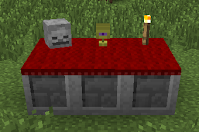 Certain objects, placed onto an altar, may boost the focusing capabilities of an altar, either improving the amount of magic it can focus, or the rate at which it replenishes. Drawing a circle  At the center of a circle, a heart glyph is always drawn using Golden Chalk. Activating this central glyph is what begins a rite. A heart glyph may be activated either by interacting with it or by giving it a redstone signal. Some more complex rites may require large circles, or in the most complex cases, multiple circles drawn inside one another. When drawing circles of different sizes around a central heart glyph there is no restriction on the type of glyph used for each complete circle. The three sizes of circle are 7x7, 11x11 and 15x15, the book Witchcraft: Circle Magic contains images of the necessary patterns. The image above shows the 7x7 pattern. The image in the section Combining Rites below, shows all three circle patterns. Performing a rite and the Book of Rites
All rite are found in the book entitled Witchcraft: Circle Magic, which must be crafted by the player. Once a rite has been selected from the book:
The rite will now begin with the items being consumed one after the other (an Arthana will not be consumed, and a charged attuned stone will lose its charge when used in a rite). Once the last item is consumed, power will be drained from the Altar (if necessary). Finally the rite's effect will begin. There is about a one second gap between each step. Grassper plants may also be placed within a circle and any items that they hold can be consumed instead of dropping the item on the floor. In this way, automation of rites may be possible. Combining rites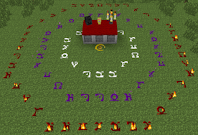 The order in which the rites are performed will generally follow the order the rites are listed in the Witchcraft: Circle Magic book. In the image on the right, a fully upgraded altar and three circles can be used for a combined rite to erect a barrier, transpose a villager and use the villager to summon a demon. This combined rite uses the Rite of Protection, Rite of Transposition and Rite of Summoning together. Binding a circle to a Circle TalismanA circle talisman allows one or more circles to be bound into the talisman, allowing the circles to be easily transported and recreated when the talisman is later used.Use the Rite of Binding described in Witchcraft: Circle Magic, with an empty circle talisman to bind the circles to the talisman. All circles and the heart glyph will be moved into the talisman. When the talisman is used on a block, all contained circles will be placed into the world centered on the block. Circle magic can be made stronger if more witches from the same coven are involved in performing a rite. If a witch or warlock wants to use their coven to perform a rite, they must use a Seer Stone to activate the heart glyph, instead of just activating it normally (which will continue to perform the normal version of the Rite). Once the ritual is started with a Seer Stone, the members of the coven will appear one-by-one and then the ritual will begin normally. Rites that have an area of effect will be larger. Curses and counter curses will start at a higher level. There are also some rites that can only be performed by a group of witches. These rites, also become more powerful the larger the coven. Some are not even possible before a large coven is assembled. To build a coven, a witch (or warlock) of sufficient skill (having a familiar helps), must find witches in the world and talk them into joining their coven. Such witches will often require a task to be fulfilled. Note that the really bad witches that live in the huts in swamps will never join a coven, so don't even bother. Using waystones to redirect ritesSome rites can use an optional Bound Waystone to send the effects of the rite to the location of that waystone. When a waystone is added to a compatible rite it must not exceed the maximum range of the coven performing the rite. A rite has a maximum range of 50 blocks plus an additional 50 blocks per coven witch involved in the rite (to a maximum of 350 blocks). Refer to the book Witchcraft: Circle Magic to find out which rites support Waystones in this way. RitesAll of the necessary steps to perform the following rites can be found in the book Witchcraft: Circle Magic.
|